Ever felt that nagging soreness in your quadriceps after a tough leg day, or perhaps a persistent tightness in your hamstrings from sitting too long? You’re not alone. Our legs bear the brunt of our daily activities, from intense workouts to simply navigating our busy lives. While stretching helps, there’s a powerful tool that can take your leg recovery to the next level: the foam roller for legs. This versatile piece of equipment isn’t just for elite athletes; it’s a game-changer for anyone looking to alleviate muscle discomfort, boost flexibility, and optimize their overall physical well-being.
What Exactly is a Foam Roller and Why Your Legs Love It?
At its core, a foam roller is a cylindrical tool used for a technique called self-myofascial release (SMR). Think of “myofascia” as the intricate web of connective tissue that surrounds and supports your muscles and organs. Sometimes, due to stress, injury, or repetitive movements, this fascia can tighten, creating “knots” or “trigger points” that restrict movement and cause pain.
Foam rolling works by applying sustained pressure to these tight spots, helping to smooth out and lengthen the fascia, much like a deep tissue massage. While it might feel a bit intense at first, the sensation is often described as a “good hurt” that ultimately leads to profound relief. For your legs, which contain some of the largest and most powerful muscle groups in your body, a foam roller is like a personal masseuse, working out the kinks and preparing them for whatever comes next.
Benefits That Will Get Your Legs Moving
Incorporating a foam roller for legs into your routine offers a cascade of advantages that extend far beyond simply feeling good.
- Reduced Soreness and Pain: This is often the primary reason people grab a foam roller. By breaking up adhesions in the fascia and increasing blood flow, foam rolling can significantly lessen post-exercise muscle soreness (DOMS – Delayed Onset Muscle Soreness) and ease chronic tightness.
- Improved Flexibility and Range of Motion: Regular foam rolling can help lengthen tight muscles, allowing for a greater range of motion in your joints. This isn’t just about touching your toes; it means more efficient movement patterns in everything from squats to running.
- Enhanced Blood Flow and Circulation: The pressure applied by a foam roller stimulates blood flow to the muscles, delivering essential nutrients and oxygen while helping to flush out metabolic waste products that contribute to soreness.
- Injury Prevention and Faster Recovery: By addressing muscle imbalances and tightness before they become major issues, foam rolling can play a key role in preventing injuries. Quicker recovery means you can get back to your activities feeling stronger and more prepared.
- Stress Relief for Muscles: Beyond the physical benefits, the act of foam rolling can also be a mindful practice. Releasing physical tension often translates to a reduction in mental stress, making it a powerful tool for holistic well-being.
Choosing the Right Foam Roller for Your Legs
With a variety of foam rollers on the market, selecting the perfect one for your legs might seem daunting. However, understanding the basic types will guide your choice.
- Smooth vs. Textured:
- Smooth Foam Rollers: These have a uniform surface, providing even pressure across the entire muscle. They are generally gentler, making them an excellent starting point for beginners or those with particularly sensitive muscles.
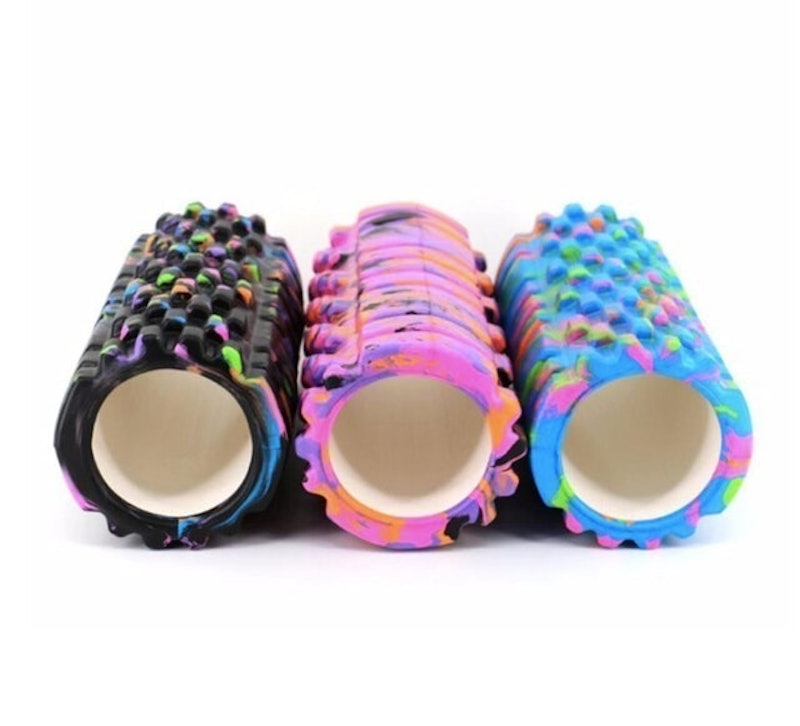
- Textured Foam Rollers: Featuring ridges, knobs, or grid patterns, these mimic the hands of a massage therapist. They dig deeper into muscle knots and provide a more intense, targeted massage, ideal for experienced users or those with stubborn tight spots.
- Density: Soft, Medium, Firm:
- Soft (Low-Density) Rollers: These compress easily and offer a gentle massage. They’re perfect if you’re new to foam rolling or have very sore muscles.
- Medium-Density Rollers: Striking a balance between comfort and effectiveness, these are suitable for most individuals and offer enough pressure to be effective without being overly intense.
- Firm (High-Density) Rollers: Designed for deep tissue massage, these are the go-to for experienced users who can tolerate significant pressure. If you’re unsure, it’s always wise to start with a less dense option and gradually increase the firmness as your body adapts.
- Size Matters for Legs:
- Long (36 inches): These are the most versatile and stable, making them great for rolling out larger muscle groups like your quads and hamstrings, and especially good for beginners who need more surface area for balance.
- Medium (18-24 inches): Handy for targeting smaller muscle groups like calves or for single-leg work, while still being long enough for many uses.
- Short (4-12 inches): Super portable, perfect for travel or focusing on very specific, smaller areas.
|
Our Picks for the Best Foam Roller in 2026
As an Amazon Associate I earn from qualifying purchases.
|
||
| Num | Product | Action |
|---|---|---|
| 1 | Yes4All High-Density EPP Round Back Roller Foam, Exercise Foam Roller for Yoga, Pilates & Stretching - 12, 18, 24, 36 inch |

|
| 2 | Amazon Basics High Density Foam Roller |
|
| 3 | Foam Roller Set - High Density Back Roller, Muscle Roller Stick,2 Foot Fasciitis Ball, Stretching Strap, Massager Ball for Whole Body Physical Therapy & Exercise, Yoga, Back Pain, Leg, Deep Tissue |
|
| 4 | TriggerPoint Grid 1.0 Foam Roller - 13\" Multi-Density Massage Roller for Deep Tissue & Muscle Recovery - Relieves Tight, Sore Muscles & Kinks, Improves Mobility & Circulation - Targets Key Body Parts |
|
| 5 | Day 1 Fitness High Density Foam Roller – Deep Tissue Muscle Massage & Myofascial Release for Recovery, Physical Therapy, Exercise & Pain Relief – Multiple Sizes & Colors |
|
| 6 | High Density Foam Roller Massager for Deep Tissue Massage of The Back and Leg Muscles - Self Myofascial Release of Painful Trigger Point Muscle Adhesions - 13\" Blue |
|
| 7 | Amazon Basics High Density Foam Roller |
|
| 8 | 321 Strong Foam Roller - Medium Density Deep Tissue Massager for Muscle Massage and Myofascial Trigger Point Release, with 4K eBook |
|
| 9 | Amazon Basics High Density Foam Roller |
|
| 10 | Amazon Basics High Density Foam Roller |
|
When considering a foam roller for legs, think about your pain tolerance, experience level, and the specific areas you want to target. A good starting point for most is a medium-density, smooth, or lightly textured roller around 36 inches long.
Your Comprehensive Guide to Foam Roller for Legs Exercises
Ready to give your legs the attention they deserve? Here’s how to effectively use a foam roller for legs, targeting key muscle groups. Remember these general principles:
- Slow and steady wins the race: Resist the urge to rush. Slow, controlled movements allow the fascia to release.
- Listen to your body: You should feel discomfort, but never sharp, shooting pain. If it hurts too much, ease off the pressure or move to a less tender area.
- Breathe deeply: This helps your muscles relax and allows you to tolerate the pressure more effectively.
- Time it right: Aim for 20-30 seconds on any particularly tender spot, and 1-2 minutes per muscle group.
Quadriceps (Front of Thighs)
How-to: Lie face down with the foam roller positioned horizontally under your quads, just above your knees. Prop yourself up on your forearms, as if in a plank position.
Movement: Using your forearms for support, slowly roll your body forward and back, moving the foam roller from just above your knees up towards your hips. You can slightly shift your weight to the right or left to target the inner or outer thigh muscles.
Tips: Keep your core engaged to protect your lower back. For less pressure, keep your toes on the ground; for more intensity, lift your feet off the floor.
Hamstrings (Back of Thighs)
How-to: Sit on the floor with your legs extended, placing the foam roller underneath your hamstrings. Place your hands on the floor behind you for support.
Movement: Lift your body so your weight is resting on the foam roller. Slowly roll up and down between the back of your knees and your glutes. You can roll both hamstrings at once or cross one leg over the other to increase pressure and isolate one hamstring.
Tips: When you find a tender spot, pause and hold for 20-30 seconds, taking deep breaths.
Calves (Lower Legs)
How-to: Sit on the floor with your legs extended, placing the foam roller under your calves, just above your ankles. Use your hands on the floor behind you for balance.
Movement: Lift your hips off the floor, so your weight rests on the foam roller. Slowly roll from your ankles up to just below your knees. To increase intensity, cross one leg over the other. You can also rotate your leg internally and externally to target different parts of the calf muscle.
Tips: Flex your ankle to engage the calf muscle. If you find a particularly tight area, pause and hold, or make small, oscillating movements.
IT Band (Outer Thigh)
How-to: Lie on your side with the foam roller positioned under your outer thigh, just below your hip. Your bottom leg should be straight, and your top leg can be bent with your foot on the floor in front of your bottom leg for support. Prop yourself up on your forearm.
Movement: Using your forearm and top leg for support, slowly roll along your IT band from just above your knee up to your hip.
Critical Note: The IT band is a thick band of connective tissue, not a muscle. While it’s common to roll it, focusing on the surrounding muscles like your glutes (gluteus maximus and medius) and the tensor fascia latae (TFL) that connect to the IT band is often more effective. Rolling directly on an inflamed IT band can worsen discomfort. Start by addressing the muscles above and around it, then gently roll the IT band itself if needed, reducing pressure by using your supporting leg.
Glutes (Buttocks)
How-to: Sit directly on the foam roller, with your knees bent and feet flat on the floor.
Movement: Shift your weight slightly onto one side (e.g., your right glute). You can cross the ankle of that leg over the opposite knee to deepen the stretch. Roll slowly up and down and side to side across the gluteal muscles.
Tips: Explore different angles to find the tightest spots. This is excellent for releasing tension that can affect your lower back and hips.
Hip Flexors (Front of Hips)
How-to: Lie face down with the foam roller positioned under one hip flexor (the front of your hip, just below your pelvic bone). Your other leg can be bent out to the side for stability. Prop yourself up on your forearms.
Movement: Slowly roll a few inches up and down, and slightly side to side, to target the hip flexor.
Tips: This area can be quite sensitive due to prolonged sitting. Start with gentle pressure and gradually increase as tolerated.
“Foam rolling your legs isn’t just about smashing muscles; it’s about re-educating your nervous system and promoting optimal tissue health. Consistency is key, and understanding the ‘why’ behind each movement makes all the difference,” advises Dr. Anya Sharma, a Sports Physiotherapist.
Common Foam Rolling Mistakes to Avoid
While a foam roller for legs is incredibly beneficial, improper technique can hinder your progress or even cause harm. Be mindful of these common pitfalls:
- Rolling Too Fast: Speed rolling might feel productive, but it prevents your tissues from properly responding to the pressure. Slow, deliberate movements are far more effective for releasing knots.
- Spending Too Long on One Spot: Lingering on a tender spot for extended periods (more than 30 seconds) can irritate nerves, damage tissue, and actually increase inflammation or cause bruising. Move slowly, but keep moving.
- Rolling Directly on Injured Areas or Joints/Bones: If you have an acute injury, avoid rolling directly on it. Similarly, steer clear of rolling directly over joints (like your knees or ankles) or bones, as this can be painful and ineffective.
- Poor Posture and Form: Foam rolling often requires you to support your body in various positions. Letting your core sag or your hips drop can reinforce bad posture or lead to new issues. Maintain an engaged core and good alignment throughout.
- Tensing Up: It’s natural to tense when you hit a tender spot. However, tensing prevents muscle relaxation, which is the whole point! Focus on deep breathing and consciously relax the muscle you’re working on.
- Not Rolling the Full Length of the Muscle: If you only roll a section of a muscle, the entire muscle won’t fully relax. Make sure you understand where a muscle originates and inserts, and aim to roll through its entire length.
- Rolling Too Hard Pre-Workout: While light foam rolling can be a great warm-up, excessively deep or intense rolling before a strenuous workout can reduce muscle tension needed for performance. Save the deeper work for post-workout or rest days.
Integrating Foam Rolling into Your Leg Workout Routine
A foam roller for legs can be a versatile companion throughout your fitness journey.
- Pre-Workout Warm-up: A few minutes of light foam rolling before your leg workout can help increase blood flow, decrease muscle density, and improve tissue extensibility, preparing your muscles for activity and potentially enhancing performance. Think of it as waking up your legs.
- Post-Workout Cool-down: This is where foam rolling truly shines for recovery. After a strenuous session, a longer, more focused foam rolling routine can help reduce muscle soreness, aid in flushing out metabolic byproducts, and kickstart the repair process.
- Rest Days for Maintenance: Don’t limit foam rolling to just workout days. Using your foam roller for legs on rest days can maintain flexibility, address any lingering tightness, and keep your muscles supple, contributing to overall mobility and well-being.
Who Should and Shouldn’t Use a Foam Roller for Legs?
Generally, a foam roller for legs is a safe and effective tool for most people.
- Should Use: Athletes, fitness enthusiasts, individuals with sedentary jobs who experience muscle tightness, anyone looking to improve flexibility, reduce soreness, or aid in muscle recovery. If you have muscle knots or feel generally stiff, a foam roller can offer significant relief.
- Shouldn’t (or Use with Caution): If you have an acute, unhealed injury (like a muscle tear or fracture), open wounds, severe osteoporosis, or certain circulatory conditions, it’s crucial to consult with a doctor or physical therapist before using a foam roller. Pregnant women should also seek medical advice. Always avoid rolling directly over joints, bones, or areas of nerve impingement.
Frequently Asked Questions About Foam Rolling Your Legs
Q: How often should I use a foam roller for my legs?
A: For best results, aim for 5-10 minutes per day, or at least 3-5 times a week. Consistency is more important than intensity.
Q: Is foam rolling supposed to hurt?
A: You should feel discomfort, often described as a “good hurt” or a deep pressure, but never sharp, radiating, or unbearable pain. If it’s truly painful, reduce pressure or move to a different area.
Q: Can foam rolling help with cellulite on legs?
A: While some anecdotal claims suggest foam rolling might help with the appearance of cellulite by improving blood flow and lymphatic drainage, there is currently no scientific evidence to conclusively prove its effectiveness for cellulite reduction.
Q: Should I foam roll before or after my workout?
A: You can do both! Light, dynamic rolling before a workout can enhance warm-up and flexibility, while a more focused session after your workout is excellent for recovery and reducing soreness.
Q: What’s the best type of foam roller for deep tissue work on legs?
A: For deep tissue work, a firm (high-density) foam roller, often with a textured surface, is generally recommended. However, always start cautiously and ensure your body can tolerate the increased pressure.
Conclusion: Empower Your Legs, Transform Your Recovery
The journey to strong, flexible, and pain-free legs is an ongoing one, and the foam roller for legs is an indispensable ally. By understanding its benefits, choosing the right tool, and mastering proper techniques, you unlock a powerful method for self-care and performance enhancement. Whether you’re an avid runner, a dedicated lifter, or simply someone who wants to move through life with greater ease, embracing foam rolling can empower your legs, accelerate your recovery, and significantly improve your overall physical well-being. Start incorporating it today, and feel the difference for yourself!