Ever felt like your Pilates practice could use a little extra something? Perhaps a tool that amplifies your movements, deepens your stretches, and even helps soothe those post-workout aches? Enter the Pilates Foam Roller – a simple yet incredibly versatile piece of equipment that can truly revolutionize your routine. If you’re looking to elevate your flexibility, strengthen your core, and achieve a more profound connection with your body, mastering the pilates foam roller is your next step.
What Exactly is a Foam Roller and Its Pilates Connection?
At its core, a foam roller is a cylindrical tool, typically made from dense foam, designed for self-myofascial release (SMR) – essentially, self-massage to relieve muscle tightness and improve blood flow. Think of it as giving yourself a deep tissue massage right in your living room. While foam rollers have been around for a while, initially gaining traction in physical therapy and athletic recovery, their integration into Pilates has been a game-changer.
Pilates, known for its emphasis on core strength, flexibility, and precise movements, finds a natural partner in the foam roller. This seemingly simple prop challenges your balance, intensifies core engagement, and facilitates deeper stretches, pushing your practice beyond what’s possible on the mat alone. It acts as an unstable surface to ignite your stabilizing muscles, and as a supportive prop to guide your body into more effective stretches and releases.
The Transformative Benefits of the Pilates Foam Roller
Incorporating a pilates foam roller into your routine isn’t just a trend; it’s a strategic move to unlock a host of physical advantages. From enhancing your body’s mechanics to speeding up recovery, the benefits are truly compelling.
Improved Flexibility and Range of Motion
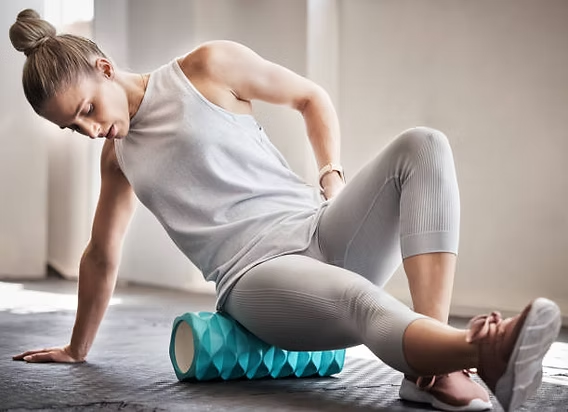
One of the standout advantages of using a foam roller is its ability to significantly boost your flexibility and range of motion. By applying sustained pressure to muscles, the roller helps break down adhesions and scar tissue, often referred to as “knots” or “trigger points.” This self-massage technique allows your muscles to lengthen more effectively, leading to smoother, more fluid movements in your Pilates exercises and everyday life. Regular use helps keep your muscles supple, making them more receptive to stretching and less prone to stiffness.
Enhanced Core Strength and Stability
Pilates is synonymous with core strength, and the foam roller takes this to another level. When you perform exercises on an unstable surface like a foam roller, your deep core stabilizing muscles have to work overtime to keep you balanced. This increased demand leads to greater proprioception – your body’s awareness of its position in space – and a more robust, responsive core. From lying on it lengthwise for controlled movements to using it as a prop for challenging balance work, the pilates foam roller is a master at activating those elusive deep abdominal muscles.
Deep Myofascial Release and Pain Relief
Chronic muscle tension can lead to discomfort and restrict movement. The foam roller excels at targeting these areas, providing deep myofascial release. “Imagine your fascia as a full-body wetsuit; when it gets tight in one area, it pulls on everything else,” explains Dr. Elara Vance, DPT and certified Pilates instructor. “Using a pilates foam roller helps release those constrictions, allowing your muscles and connective tissues to move more freely, which in turn can alleviate pain and promote overall comfort.” This self-massage effect is like having a portable soft tissue therapist.
Better Posture and Spinal Alignment
Many of us spend hours hunched over desks or devices, leading to poor posture and spinal misalignment. A pilates foam roller can be a powerful ally in correcting these imbalances. By gently rolling along your upper back and shoulders, it helps to release tension in tight pectoral muscles and opens up the chest, encouraging a more upright and aligned spine. Exercises that involve lying lengthwise on the roller can help decompress the spine and restore its natural curves, fostering better posture both inside and outside your Pilates practice.
Accelerated Muscle Recovery and Injury Prevention
Whether you’re an avid athlete or just starting your fitness journey, muscle recovery is crucial. Foam rolling increases blood flow and circulation to your muscles, delivering essential oxygen and nutrients needed for repair and growth. This enhanced circulation can significantly reduce delayed onset muscle soreness (DOMS) and speed up the healing process after your workouts. Moreover, by addressing muscle imbalances and tightness, the pilates foam roller plays a key role in preventing injuries that might arise from overstrained or inflexible muscles.
|
Our Picks for the Best Foam Roller in 2026
As an Amazon Associate I earn from qualifying purchases.
|
||
| Num | Product | Action |
|---|---|---|
| 1 | High Density Foam Roller Massager for Deep Tissue Massage of The Back and Leg Muscles - Self Myofascial Release of Painful Trigger Point Muscle Adhesions - 13\" Blue |

|
| 2 | Amazon Basics High Density Foam Roller |
|
| 3 | Foam Roller Set - High Density Back Roller, Muscle Roller Stick,2 Foot Fasciitis Ball, Stretching Strap, Massager Ball for Whole Body Physical Therapy & Exercise, Yoga, Back Pain, Leg, Deep Tissue |
|
| 4 | Amazon Basics High Density Foam Roller |
|
| 5 | Day 1 Fitness High Density Foam Roller – Deep Tissue Muscle Massage & Myofascial Release for Recovery, Physical Therapy, Exercise & Pain Relief – Multiple Sizes & Colors |
|
| 6 | TriggerPoint Grid 1.0 Foam Roller - 13\" Multi-Density Massage Roller for Deep Tissue & Muscle Recovery - Relieves Tight, Sore Muscles & Kinks, Improves Mobility & Circulation - Targets Key Body Parts |
|
| 7 | Amazon Basics High Density Foam Roller |
|
| 8 | 321 Strong Foam Roller - Medium Density Deep Tissue Massager for Muscle Massage and Myofascial Trigger Point Release, with 4K eBook |
|
| 9 | Amazon Basics High Density Foam Roller |
|
| 10 | Yes4All High-Density EPP Round Back Roller Foam, Exercise Foam Roller for Yoga, Pilates & Stretching - 12, 18, 24, 36 inch |
|
Choosing Your Perfect Pilates Foam Roller: A Guide
Selecting the right pilates foam roller can make a big difference in your practice. They come in various specifications, each offering a unique experience.
Length
The most common and versatile length is the 36-inch (full-length) roller. This size is ideal for Pilates as it allows you to lie on it lengthwise, supporting your entire spine from head to tailbone, which is essential for many core and stability exercises. Shorter rollers (around 12-18 inches) are great for targeted spot treatment, travel, or working on smaller muscle groups, but won’t offer full spinal support.
Firmness
- Soft/Low-density: These rollers offer a gentler touch. They’re excellent for beginners, individuals with sensitive muscles, or those recovering from injuries. They provide supportive feedback without excessive pressure, making them suitable for relaxation and rehabilitation.
- Medium-density: Often considered the all-purpose roller, a medium-density foam roller is a great choice if you’re looking for a balance between comfort and effective pressure. It’s versatile enough for both specific exercises and general stretching.
- Firm/High-density: Athletes and those with very tight muscles often prefer firm rollers for a deeper, more intense massage. They provide maximum feedback and challenge, making them ideal for advanced users seeking profound myofascial release and heightened balance challenges.
Surface Texture
- Smooth: A smooth surface foam roller is widely recommended for general Pilates practice. It provides even pressure and is excellent for a broad range of exercises, from core stability work to gentle spinal articulation.
- Textured/Bumpy/Knobbly: These rollers feature ridges, knobs, or bumps designed to “dig in” more deeply, targeting specific trigger points or muscle knots with greater intensity. While effective for deep tissue work, they can be more uncomfortable for beginners and less versatile for balance-focused Pilates movements.
Shape
Most Pilates foam rollers are full-round cylinders. However, half-round rollers are also available. These semi-circular rollers offer increased stability, making them an excellent choice for beginners who need extra support while still gaining the benefits of an elevated, unstable surface for certain exercises.
Detailed Guide: Mastering Pilates Foam Roller Exercises
Ready to roll? Here’s how you can integrate the pilates foam roller into your workout. Remember to move slowly and with intention.
Warm-up and Preparation
Before diving into intense rolling, start with a gentle warm-up. Light cardiovascular activity for a few minutes can get your blood flowing. Then, use the foam roller for some preliminary, gentle rolls to introduce your muscles to the sensation.
Core-Focused Exercises
- Spinal Articulation (Supine on Roller):
- Lie lengthwise on your foam roller, ensuring your head and tailbone are supported. Bend your knees, feet flat on the floor, hip-width apart.
- Engage your core as you gently rock your pelvis towards your belly button, feeling your lower spine connect with the roller.
- Slowly return to a neutral spine. Repeat 8-10 times, focusing on each vertebra.
- This movement helps to warm up the spine and awaken deep abdominal muscles, crucial for all Pilates exercises.
- Marching (Supine on Roller):
- From the same supine position on the roller, keep your arms at your sides for stability.
- Inhale, then as you exhale, slowly lift one knee towards your chest, maintaining a stable pelvis.
- Inhale to hold, then exhale to slowly lower the foot back down. Alternate legs for 10-12 repetitions on each side.
- This challenges your core stability by introducing an element of instability, making your core work harder to prevent wobbling.
- Chest Lift (on Roller):
- Still lengthwise on the roller, place your hands behind your head, elbows wide.
- Exhale as you gently curl your upper body forward into a chest lift, drawing your navel towards your spine.
- Inhale as you slowly lower back down. Repeat 8-10 times.
- The roller adds an extra dimension of instability, requiring deeper core engagement than a traditional chest lift on the mat.
Flexibility and Release for Major Muscle Groups
- Upper Back and Shoulders (Thoracic Extension):
- Place the foam roller horizontally across your mat, just below your shoulder blades. Support your head with your hands.
- Keeping your hips on the floor, gently arch your upper back over the roller on an inhale, opening your chest.
- Exhale and return to the starting position. Slowly roll the roller up and down your upper back, pausing on tight spots. Avoid rolling on your lower back.
- This exercise is fantastic for improving thoracic spine mobility, essential for good posture and relieving tension from desk work.
- Hips and Glutes (Figure-4 Stretch):
- Sit on the foam roller, placing it horizontally under your glutes. Cross one ankle over the opposite knee, creating a figure-4 shape.
- Gently lean into the hip of the crossed leg, rolling a few inches back and forth, pausing on any sore spots.
- Repeat on the other side.
- Targets the glutes and piriformis, helping to relieve tightness that can contribute to hip or lower back pain.
- Hamstrings:
- Sit on the floor with straight legs, placing the foam roller under your hamstrings. Use your hands for support behind you.
- Gently lift your hips and roll slowly from just below your glutes to just above your knees.
- You can roll both legs simultaneously or one at a time for deeper pressure.
- Releases tightness in the hamstrings, which can improve flexibility and reduce strain on the lower back.
- Quadriceps:
- Lie face down, placing the foam roller horizontally under your thighs. Support yourself on your forearms.
- Roll slowly from just below your hip flexors to just above your knees.
- For more intensity, place one leg off the roller.
- Addresses tight quads, common in many daily activities and exercises.
- Calves:
- Sit on the floor with legs extended, placing the foam roller under your calves. You can cross one leg over the other for added pressure.
- Using your hands for support, gently lift your hips and roll slowly from your ankles to just below your knees.
- Helps release tension in the calf muscles, improving ankle mobility and reducing foot and lower leg discomfort.
Balance Challenges
- Single Leg Circles (Supine with Roller under Ankles):
- Lie on your back, arms by your sides. Place the foam roller horizontally under your ankles.
- Lift one leg straight towards the ceiling, aligning it with your hip.
- Inhale, then exhale as you draw a small circle on the ceiling with your big toe, keeping the movement controlled and your pelvis stable on the floor.
- Repeat 3-5 times in each direction, then switch legs.
- The roller beneath the non-working leg adds instability, demanding greater core control and balance.
Tips for Effective Foam Rolling and Common Pitfalls to Avoid
To get the most out of your pilates foam roller and ensure safety, keep these pointers in mind:
- Slow and Controlled Movements: Resist the urge to rush. Rolling slowly allows your muscles and fascia time to respond and release.
- Listen to Your Body: Discomfort is normal when addressing tight spots, but sharp or intense pain is a warning sign. If it hurts too much, ease up on the pressure or move to a less sensitive area.
- Stay Hydrated: Water is crucial for healthy fascia. Good hydration enhances the effectiveness of foam rolling.
- Don’t Roll Directly on Joints or Lower Back: Focus on muscle tissue. Your lower back, in particular, should generally be avoided; for specific lower back release, consult an expert or use smaller tools like a tennis ball.
- Consistency is Key: Like any exercise, regular foam rolling yields the best results. Aim for a few times a week, or as needed for specific muscle groups.
Integrating Your Pilates Foam Roller into Your Routine
The beauty of the pilates foam roller is its adaptability. You can weave it into various parts of your fitness regimen:
- Pre-Workout Warm-up: A few minutes of gentle rolling before your Pilates session or any workout can help warm up your muscles, increase blood flow, and prepare your body for movement.
- During Matwork for Enhanced Challenge: Use the roller to deepen traditional Pilates exercises. For instance, balancing on it during abdominal work intensifies core engagement, while using it under your feet for bridging adds instability.
- Post-Workout Recovery: After a challenging session, the foam roller is your best friend for cooling down and facilitating muscle recovery, reducing soreness, and maintaining flexibility.
Who Should Embrace the Pilates Foam Roller (and Who Should Be Cautious)?
The pilates foam roller is a fantastic tool for almost anyone looking to improve their physical well-being. From seasoned Pilates practitioners seeking to deepen their practice, to beginners aiming for better body awareness and flexibility, it offers immense value. Athletes, individuals with sedentary jobs, and those experiencing general muscle stiffness can all benefit greatly.
However, certain individuals should approach foam rolling with caution or consult a healthcare professional first. This includes people with conditions like osteoporosis, acute injuries, varicose veins, or those who are pregnant. Always prioritize safety and listen to your body’s signals. If you’re unsure, a certified Pilates instructor or physical therapist can guide you on proper techniques and modifications.
Conclusion
The pilates foam roller is far more than just a piece of foam; it’s a powerful instrument for enhancing your body’s flexibility, strength, and overall well-being. By integrating this versatile tool into your Pilates practice, you’ll not only deepen your connection to your core but also unlock a new level of physical freedom and comfort. So, grab your roller, embrace the challenge, and prepare to discover a more aligned, resilient, and responsive you. Your body will thank you for it!